

The Cure for Loneliness Isn't a Golf Simulator. It’s a Neighborhood.
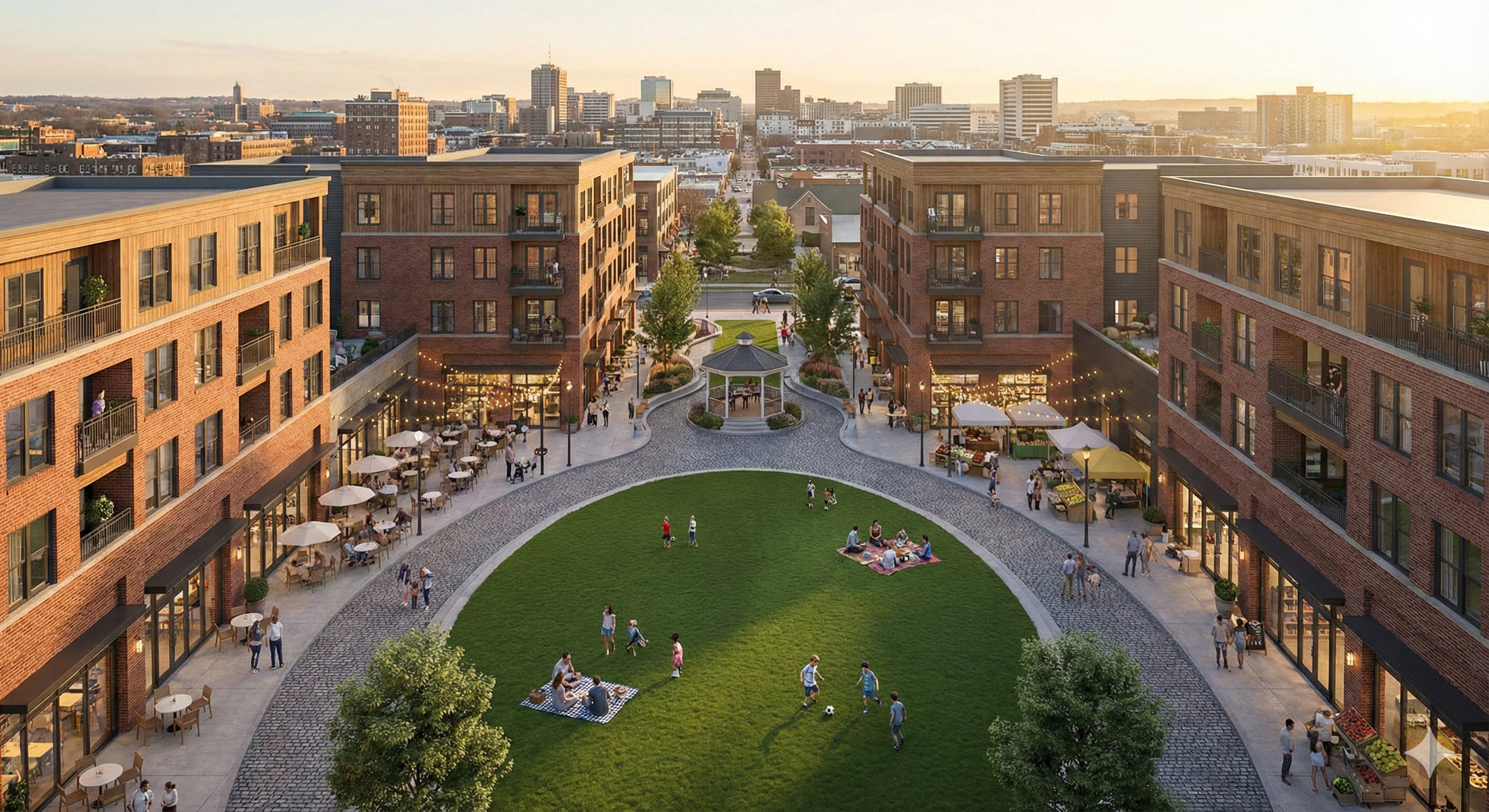
The Power of the Central Green: This rendering illustrates the 'Village' concept over the 'Project' concept. Instead of a parking lot, the development is anchored by a pedestrian-focused lawn, a true 'Third Place' where retail spills out onto the sidewalk and residents have a reason to linger and connect.
There is a lot of criticism online right now regarding "Luxury Amenities" in multifamily developments. Critics argue that golf simulators, sky lounges, and resort-style pools are a waste of space—soulless perks that drive up rent without adding real value. They argue we should strip them out and just build cheaper units.
I disagree.
Amenities are actually a powerful tool—if used correctly. When I lived in Dallas, I met my close friends at the building pool. Why? Because the property management didn't just treat it as a hole in the ground; they used it as a stage for community, hosting parties and events. If you make a lifelong friend playing pool on a roof terrace, that amenity has done its job.
The real crisis isn't the amenities inside our buildings. It is the lack of amenities outside of them.
The "Chick-fil-A" Problem
In too many American cities, we have mastered the art of "Housing," but we have forgotten how to build "Communities."
We see urban sprawl as far as the eye can see—miles of houses with nothing interconnecting them. In these environments, the only "Third Place" (a place that isn't work or home) is often a concrete shopping plaza with a Walmart, a Lowe’s, and a Chick-fil-A.
These are transactional spaces. You go there to buy a chicken sandwich, and you leave. You don’t "hang out." You don’t meet your neighbor.
We are lonely because we are building environments where the only way to connect with the world is through a car window.
New Urbanism: The Geometry Problem

Designing the 'Third Place': A rendering of the central lawn and food court at The District in Katy, Texas. Instead of a standard retail strip, we anchored the development with a flexible green space and splash pad. This creates a destination where families can picnic, exercise, and dine—proving that people will linger if you build a stage for community.
I love the philosophy of New Urbanism. But in practice, I see it failing over and over again.
Too many developers treat New Urbanism like a geometry problem. They focus on density calculations, how to line up the houses, and how to stack the units efficiently. They are checking boxes on a site plan, but they are failing to create the "Small Town Feel" that the philosophy promises.
The Missing Link: Experience Design We need to stop thinking like Master Planners and start thinking like Rick Caruso (creator of The Grove) or Walt Disney.
Caruso and Disney understood that humans crave an experience, not just goods. They built what I call "Stages for Life"—fountains, plazas, and parks where you don't have to buy anything to belong.
How does the user feel in the space?
Is there a reason to linger?
Is there a "Main Street" energy, or just a row of shops?
The Solution: The Central Green

I have worked on three major projects that prioritized the "Third Place" over simple density: Midtown Tampa (Bromley Companies), 505 Riverfront (Dallas), and Katy Square (Texas).
In all three projects, we didn't just drop in a hotel or a big-box store like Target. We anchored the entire development with a Central Green.
This green space functions like the town lawn of a historic New England village, or—to use a Pittsburgh example—like the great lawn in Schenley Park.
It’s a place to play soccer.
It’s a place to sunbathe.
It’s a place to hold outdoor concerts.
The Business Case for Loitering There is a misconception that "loitering" is bad for business. In reality, when you create a Central Green, you support the businesses around it. The coffee shops and restaurants flanking that green thrive on a business model based on community presence. They become the "Third Place" where people see the same faces every day.
Hardware vs. Software: The Lesson of Uptown Dallas
Finally, we have to talk about Stewardship. You can build the perfect "Central Green" (the Hardware), but if you don't manage it (the Software), it will fail.
The gold standard for this is Uptown Dallas.
When I lived there, the neighborhood was a living ecosystem. I walked 1.5 miles to my office in Downtown Dallas every day and felt entirely safe. This wasn't an accident. It was the result of Uptown Dallas Inc., the organization that acted as the steward of the neighborhood.
They didn't just maintain the sidewalks; they activated them.

The Micro-Neighborhood: A rendering of the playground and pocket park at The District in Katy. We designed this space to be a multi-generational hub. By placing the play area directly next to outdoor dining and a community movie screen, we created a safe 'Third Place' where parents can relax while children play—turning a simple open space into the heart of the neighborhood.
Connectivity: They managed the historic McKinney Avenue Trolley, which wasn't just transit—it was a moving social hub.
Programming: They hosted "Movie Nights in the Park" that gave neighbors an excuse to sit on the grass together.
The Verdict
Individual buildings make up a whole. But that whole needs to serve human beings who are feeling increasingly disconnected.
The challenge for Architects and Developers today is to stop looking at the property line as the edge of our responsibility. If we build a 300-unit apartment complex but the only place to walk is a highway shoulder, we have failed.
Don't just build a development. Build a place to hang out.
Are you looking to create a Community, not just a Complex? At David Stumpf Architecture, we specialize in site planning and architectural design that prioritizes the human experience. Contact Us Today to discuss your next project.
