

Beyond the Glass Box: Why the Next Era of Development Belongs to Tradition
If you look at the real estate development landscape in 2025, we are seeing a "Tale of Two Markets."
In the Sun Belt (cities like Miami, Dallas, and Austin) we are witnessing the hangover of the post-2020 capital flood. Developers rushed to build the easiest product possible: the 1-bedroom "people box." Now, as thousands of these identical units come online simultaneously, we are seeing a war on concessions. The market is flooded with product designed for a 2021 pro-forma, not a 2025 reality.
But here in the Northeast and Rust Belt, we face a different challenge. In supply-constrained markets like Buffalo and Pittsburgh, there is growing demand from families and young professionals, but very little new inventory.
Unfortunately, many developers are trying to solve this by playing a game of "catch-up." They are looking at the boomtowns of the South and copying the wrong homework.
The "Lazy Design" Trap
I see it everywhere: Developers in historic, masonry-rich cities putting up fiber-cement boxes that look exactly like the fast-casual apartments in Charlotte or Raleigh.
We are trading our architectural heritage for a cheap imitation of a trend that is already dying.
Across social media and the broader market, the "Sleek Contemporary" look is fading. The "Modern Farmhouse" is out. We are on the verge of a massive cultural shift: The Return to Tradition.
People are craving warmth. They are craving weight. They are craving privacy. If you are a developer looking to stay ahead of the curve, here is the pragmatic fix for the next cycle of development.
1. Kill the "Open Plan"
The Pandemic taught us that the "Open Concept" is a nightmare for actual living. You can’t work with a kid climbing on you. You can’t study with the TV blaring in the same "Great Room."
The new luxury isn't openness; it is Connection. Residents want defined rooms. They want acoustics that work. They want a dining room that feels like a destination, not just a table floating in a hallway. Privacy is the asset that sells.
2. Materiality is the New Amenity
For too long, we have wrapped buildings in disposable materials—aluminum, fiber cement, and thin panels—that look tired in ten years.
To compete in 2025 and beyond, we need to build "Institutional Class" assets. Whether it is a high-rise in a non-coastal city or a low-rise infill project, the building should look Regal, not corporate. We need to stop fearing masonry. Brick and cast stone signal longevity and quality to a tenant in a way that a fiber-cement panel never will.
3. Respect the Human Scale
The "Lazy High-Rise" shoots straight up from the sidewalk, intimidating pedestrians and blocking light.
The fix is simple: Step the building back at the 3rd or 4th floor. Create a "Brownstone" feel at the street level with stoops, heavy masonry, and engagement. This doesn't just improve the streetscape; it creates massive value for the terrace units created at the setback line.
4. Solve the "Missing Middle"
The market is saturated with studios and 1-bedrooms. The underserved demographic is the growing family that cannot find a 3-bedroom rental.
Yes, a 3-bedroom unit costs more to build. But in a supply-constrained market, that is where the longevity lies. By strictly chasing the highest unit count, developers are missing the most stable tenant base in the market.
The Verdict
We are building "Anywhere, USA" and calling it Luxury, and buyers are starting to notice.
The market is moving away from the "Cold Glass Box." The developers who embrace warmth, privacy, and tradition are the ones who will define the next decade of real estate.
Are you a developer looking to build Institutional Class assets? At David Stumpf Architecture, we specialize in high-performance, market-driven design that stands the test of time. Contact Us Today to discuss your next project.

A stark visual comparison defining the current moment in real estate development. On the left ("THE TREND") is the ubiquitous, cold glass tower—the symbol of "lazy design." On the right ("THE TRADITION") is the future of luxury: a building with warmth, architectural weight, and timeless masonry detailing.
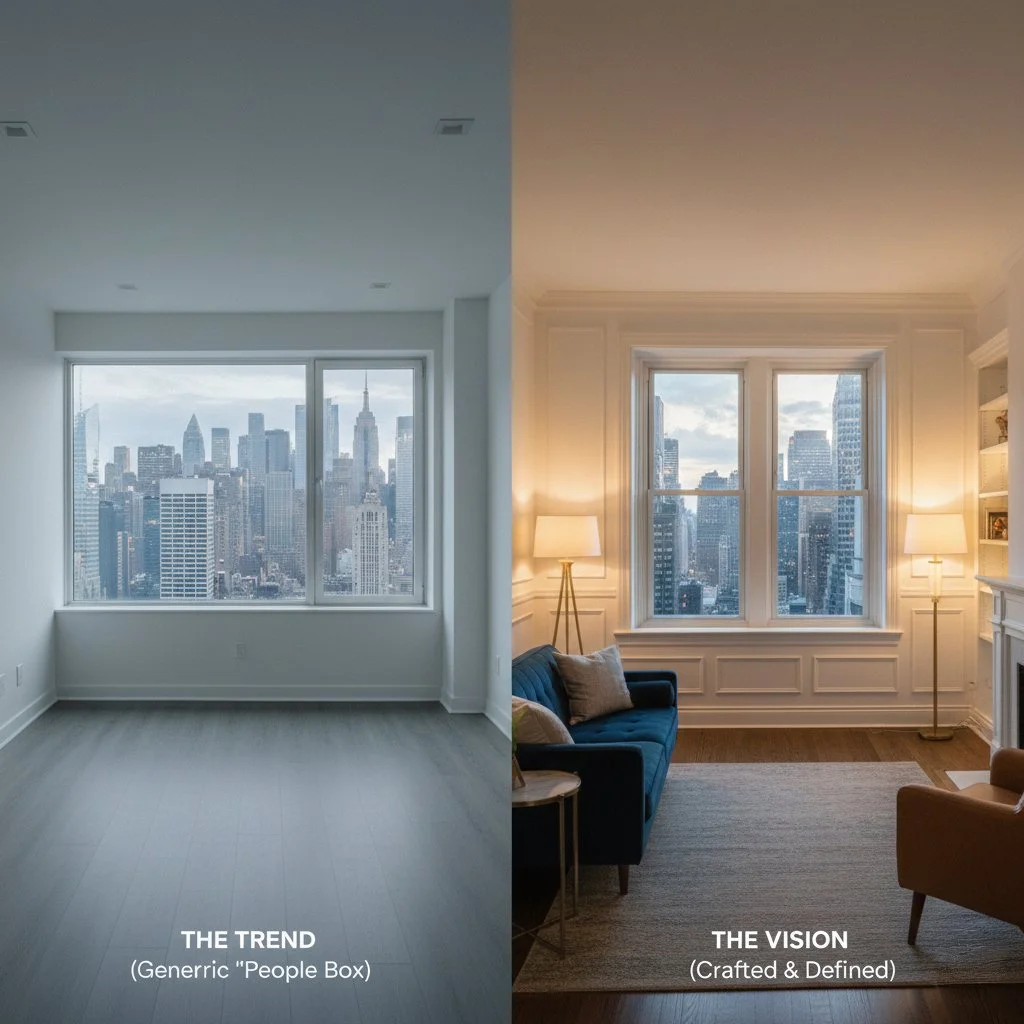
A tale of two interiors. The left shows the generic "people box" commonly built today; undefined, open, and cold. The right demonstrates the new definition of luxury: defined spaces, rich molding, and a sense of permanent shelter.

An example of how to build "Institutional Class" assets. The foreground building respects the pedestrian with warm masonry, arches, and a human scale, standing in sharp contrast to the intimidating, anonymous glass tower looming in the background.
