

The ROI Problem in Orchard Park: How Zoning Limits Threaten Buffalo’s New Stadium District

This rendering illustrates the potential of a true 'Stadium District.' Unlike the current sea of asphalt, this vision shows the stadium fully integrated into a dense, walkable urban fabric.
The news out of Orchard Park is directionally correct. The Town Board has officially approved rezoning 300 acres around the new Buffalo Bills Stadium to guide future growth.
This is a massive win for the region. It acknowledges a fundamental truth: a billion-dollar stadium shouldn't just be a parking lot you visit eight times a year. It should be an economic engine and a destination 365 days a year.
But there is a fatal flaw in the fine print. The new regulations cap building heights at 35 feet.

Imagine stepping out onto your apartment balcony on a snowy Sunday. Instead of looking out over a frozen sea of asphalt, you look down onto a vibrant Pedestrian Promenade alive with energy.
This rendering captures the true vision for the Stadium District. It illustrates a lively, year-round neighborhood where residents can watch the game day atmosphere build from their own homes. The warm glow of fire pits, string lights, and active ground-floor retail creates a destination that thrives even in the winter. This level of immersion and activity is what we lose if we settle for low-density zoning. We need to prioritize building a lively district, not just a venue.
If we look at these constraints closely, we are sleepwalking into a planning disaster. We have a binary choice: We can build a destination residents are proud of, or we can build another "Transit Road."
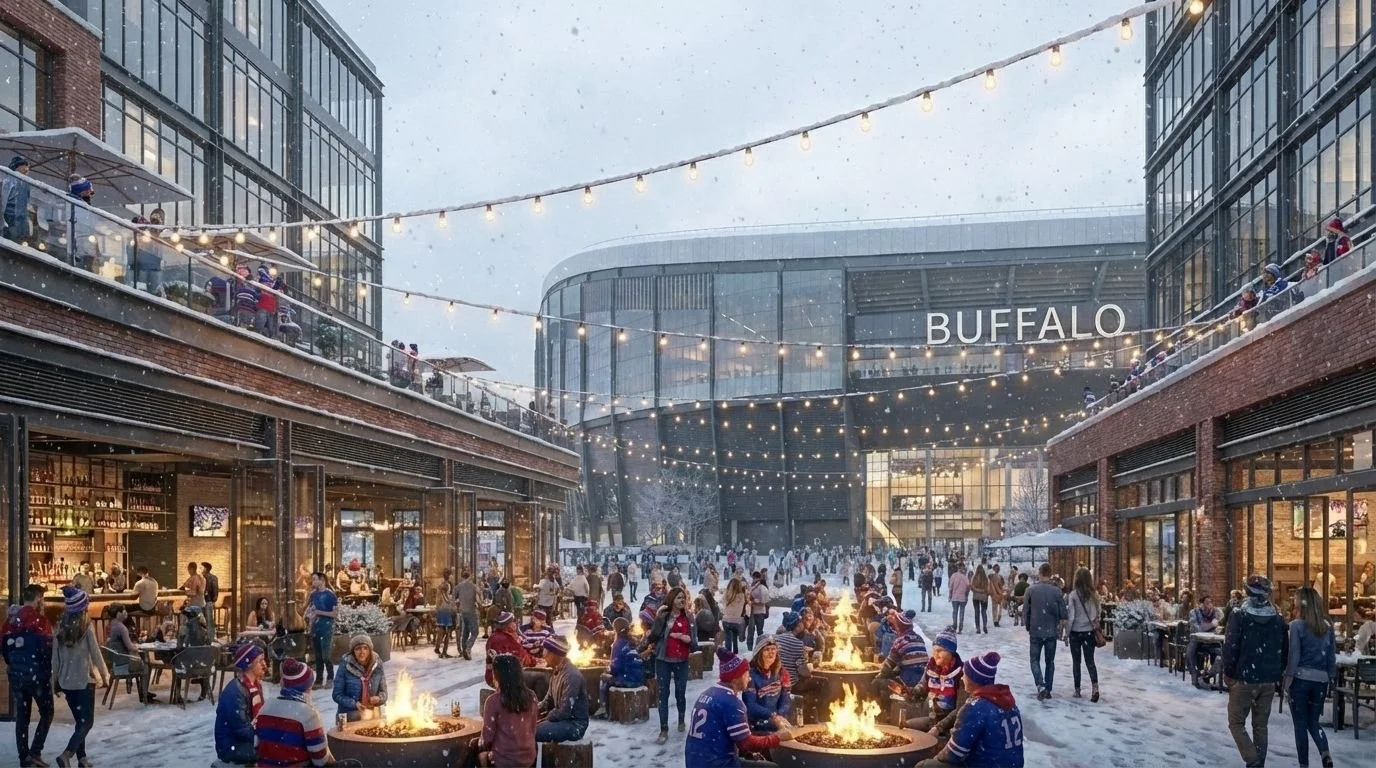
At the street level, the energy is palpable. The ground floors are porous, featuring restaurants and retail that spill out onto a grand pedestrian plaza. This isn't just a place to park; it is a place to linger. The architecture creates a 'living room' effect for the town, turning a game-day venue into a year-round economic engine.
Unfortunately, the current code encourages the latter. Here is the technical reality of why the 35-foot cap fails "Productive Development" and why we need to change course before the concrete is poured.
Key Takeaways:
The Problem: New Orchard Park zoning caps heights at 35 feet, limiting buildings to two stories.
The Consequence: Low density makes underground parking unaffordable, forcing surface lots and "sprawl."
The Economic Impact: Experts like Paul Ciminelli argue the current cap makes development unmarketable.
The Solution: Raising the limit to 4-6 stories to allow for true mixed-use density and walkability.
1. Market Viability: Why Developers Avoid Low-Density Zoning
I am not alone in this assessment. Paul Ciminelli, CEO of Ciminelli Real Estate, recently stated regarding this 35-foot cap: “That, alone, makes it not marketable to developers.”
This is the first litmus test of any zoning code. If the people with the capital to build the district say the math doesn't work, the district doesn't get built—or at least, not the version we were promised. When you cap potential revenue (square footage) but land costs and construction costs remain high, the project creates negative leverage.
2. Architectural Reality: Why Mixed-Use Requires More Than 35 Feet
There is a misconception that developers can simply "get creative" to squeeze a mixed-use building into a 35-foot envelope. As an architect, I can tell you that the geometry simply does not fit.
To create a vibrant "Village" feel, you typically want retail on the ground floor with residential or office units above. Let’s look at the vertical cross-section required to make that happen:
The Retail Base: Productive, high-quality retail (restaurants, shops) requires 12–14 foot ceilings. Anything lower feels oppressive and limits the type of tenants you can attract.
The Structure: You need 14–16 inches between floors for trusses, MEP (mechanical, electrical, plumbing), and soundproofing.
The Residential/Office Levels: Marketable units need 10-foot ceilings, plus the corresponding 16 inches of structure above them.
The Result: By the time you account for a proper ground floor and the necessary infrastructure, you run out of room before you finish the 3rd floor.
We are effectively zoning for 2-story buildings. And that leads us to the next problem.

This diagram illustrates the invisible force that shapes our cities: Enclosure.
The top section shows the reality of a 35-foot height cap. The buildings are too low to frame the space, resulting in a vast, exposed parking lot that feels like a strip mall. The energy leaks out.
The bottom section shows the 'Village Standard.' By allowing 4-5 stories, the buildings create an 'outdoor room.' This verticality creates the cozy, protected feeling that makes pedestrian streets successful. You cannot build the bottom image with the top image's zoning code. It is geometrically impossible
3. The Sprawl Trap: How Low Height Limits Increase Surface Parking
Height and parking are inextricably linked.
Because the zoning caps developers at two stories, they cannot achieve the density (revenue per acre) required to pay for expensive infrastructure like underground parking or structured parking decks.
The Consequence: Developers are forced to rely on the cheapest option available—surface parking lots. The Reality: This creates "Horizontal Density," which is just a fancy word for Sprawl.
Instead of a tight, walkable village where buildings frame the street, you get a "strip mall with a sidewalk"—buildings pushed apart by seas of asphalt. This destroys the pedestrian experience before it even begins.
4. The "Enclosure" Principle
Great developers like Rick Caruso (The Grove) or the teams behind Disney’s town centers understand a fundamental rule of urban design: The Enclosure Principle.
To create a street that feels "walkable," safe, and inviting, you need a specific ratio of building height to street width. Verticality creates a sense of an "outdoor room." It holds the energy on the street.
The Failure: At 35 feet, the scale is too low for the width of the streets and plazas planned. The energy "leaks out" into the sky. The environment feels exposed, suburban, and car-centric. It creates a space you drive through, not a place you linger in on a Tuesday in March.

Low-density "garden apartments" and strip malls drowning in a sea of asphalt. This is the "Transit Road" outcome we must avoid.
5. What We Must Inhibit
Rezoning isn't just about what you allow; it's about what you forbid. If we want to avoid "Transit Road 2.0," the code must effectively ban the typologies that have plagued Western NY planning for decades:
No "Garden" Apartments: We must stop building spread-out, low-density residential complexes surrounded by moats of asphalt.
No Set-Back Retail: We must prohibit single-story shops pushed back behind parking lots.

This is the 'Business as Usual' approach. While the stadium itself is state-of-the-art, the surrounding plan remains stuck in the 1970s.
In this rendering, we see the massive investment of the new stadium completely isolated by acres of surface parking. There is no 'neighborhood,' no 'sense of place,' and no reason to stay after the game ends. This design prioritizes car storage over human experience, guaranteeing that the economic impact remains confined to just eight days a year.
The ROI Connection
As I wrote previously: ROI isn't calculated on a spreadsheet; it is designed.
You design for the Human Experience, and the ROI follows. By zoning out the Experience (Density, Enclosure, Walkability), the Town is effectively zoning out the ROI.
We have a generational opportunity to build a world-class destination next to a world-class stadium. Do not let this site become a strip mall.
A Challenge to Land Owners & Developers
If you own land in the Stadium District, or if you are considering development here, I am making an offer.
I will help you pro-bono.
I will help you visualize your site's potential and build a technical case to present to the Council for raising the height limit. We need to show them what "World Class" actually looks like, and why density is the key to unlocking it.
Contact me today, and let's get to work.
